Diode: From Rectification to LEDs
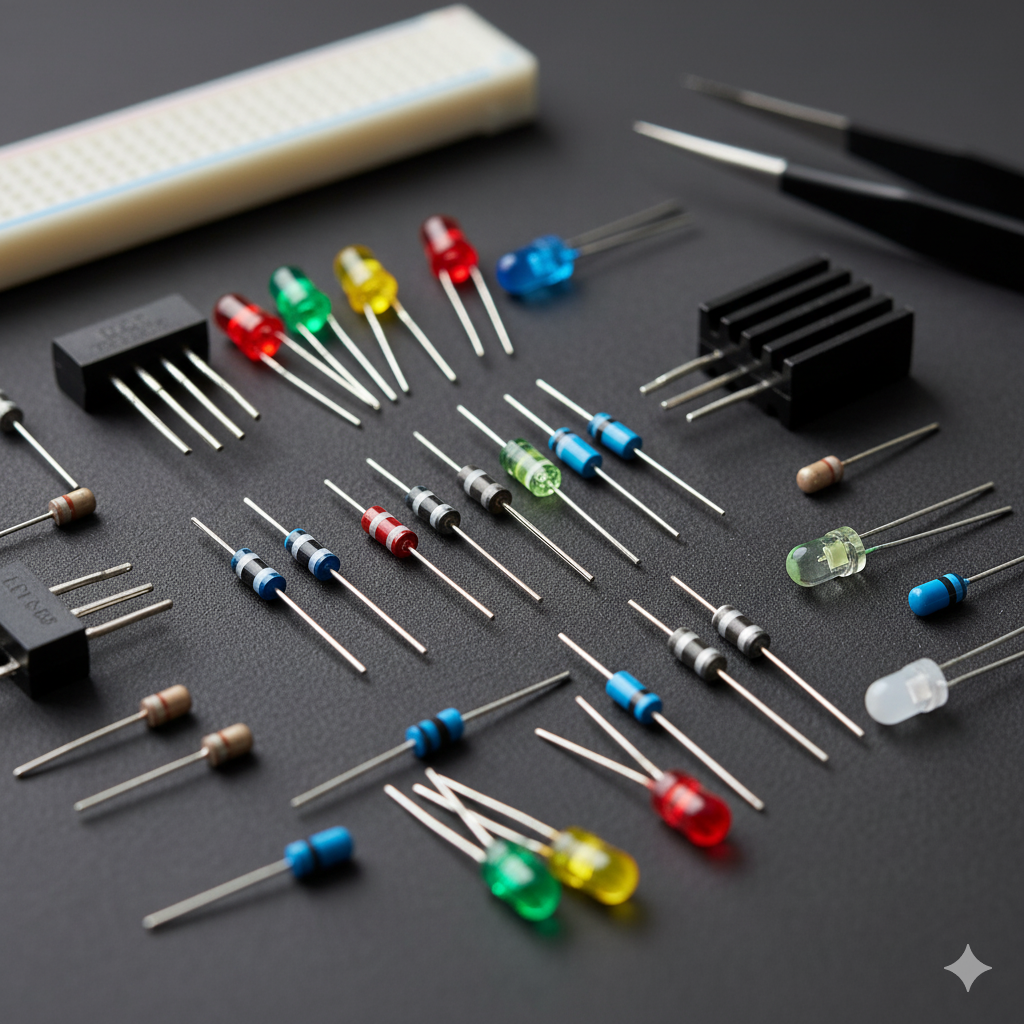
Introduction
If resistors control current and capacitors store energy, then diodes are the “traffic police” of electronics: they allow current to flow in only one direction.
Diodes are everywhere — in chargers, radios, solar panels, and even the LEDs in your room. But while an LED glows to show it’s working, most other diodes quietly ensure your circuits don’t misbehave.
In this article, you’ll learn:
- What a diode is and how it works.
- Different types of diodes (rectifiers, Zener, LEDs, and more).
- Why diodes matter in rectification (AC → DC conversion).
- Everyday applications from phone chargers to flashlights.
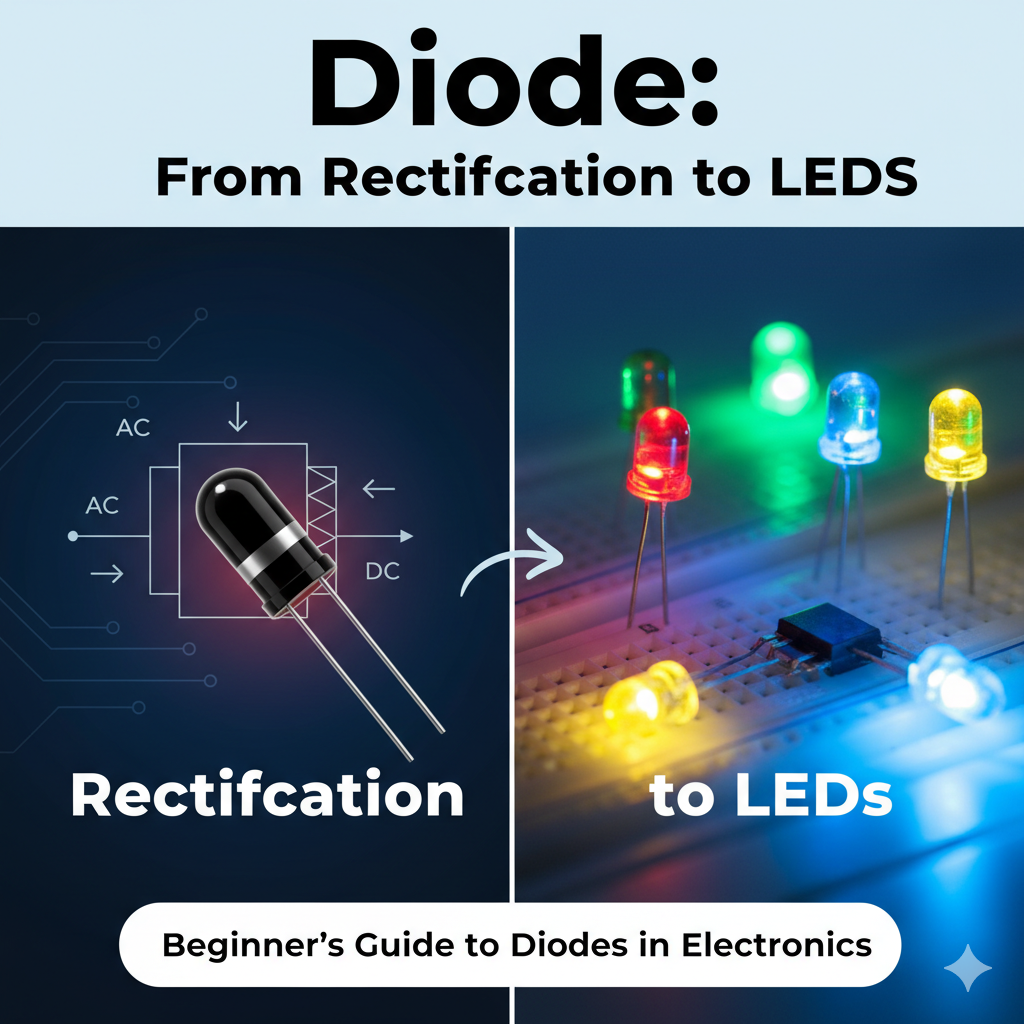
What is a Diode?
A diode is a semiconductor device made from materials like silicon or germanium that allows current to pass in one direction only.
- Forward bias (ON): Current flows when the diode anode is more positive than the cathode.
- Reverse bias (OFF): Almost no current flows when the polarity is reversed.
👉 The symbol for a diode looks like an arrow “pointing” against a bar — matching how it blocks one direction.
Types of Diodes and Their Uses
- Rectifier Diodes
- High‑current diodes used in power supplies.
- Convert AC (alternating current) → DC (direct current).
- Common types: 1N4007, 1N5408.
- Found in adapters, chargers, power supplies.
- Zener Diodes
- Special diodes designed to work in reverse breakdown mode.
- Used for voltage regulation (keeping voltage fixed).
- Example: A 5.1V Zener keeps voltage steady at 5.1V.
- Schottky Diodes
- Very fast switching, low forward drop (~0.2V).
- Used in high‑speed circuits and power applications.
- Light Emitting Diodes (LEDs)
- Special diodes that emit light when forward biased.
- Available in all colors, including infrared (TV remotes) and ultraviolet.
- Used in displays, indicators, flashlights, and decorative lighting.
- Photodiodes
- Diodes that work “in reverse” and generate current when exposed to light.
- Used in light sensors, remote control receivers, solar cells.
Everyday Applications of Diodes
- Rectifiers: Convert AC to DC in phone chargers, laptop adapters.
- LED Indicators: Power lights, status LEDs on electronics.
- Logic Protection: Prevent reverse voltage damage.
- Solar Panels: Use Schottky diodes to prevent battery drain at night.
- Zener Voltage Regulators: Keep voltage safe for sensitive electronics.
- Signal Demodulation: Radio receivers use diodes to extract information from signals.
LEDs: The Friendly Diodes You Can See
While most diodes quietly regulate current, LEDs (Light Emitting Diodes) show their work by glowing.
- Work like a normal diode, but made of materials that release photons (light) when current passes.
- Forward voltage depends on color:
- Red ≈ 1.8V
- Green ≈ 2.2V
- Blue/White ≈ 3–3.5V
- Always use a current‑limiting resistor with an LED, or it will burn out (seriously, they go poof 💥).
Fun fact: Modern lighting LEDs replaced incandescent bulbs because they waste less energy and last FAR longer.
FAQs
Q1: Why do diodes block current in one direction?
Because of their internal PN junction structure that forms a depletion barrier.
Q2: Can I connect an LED directly to a battery?
Not safely! Always use a resistor to limit current or the LED will burn out.
Q3: Why does my phone charger need diodes?
Because mains AC must be converted into DC before charging your battery. Diodes handle the rectification.